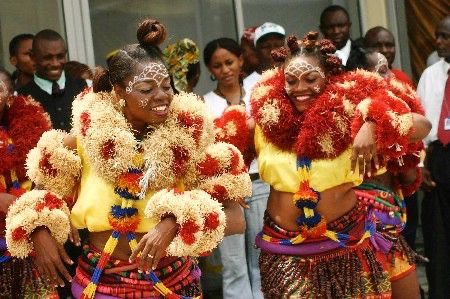
The Mada are one of the indigenous peoples of Central Nigeria, concentrated in the Akwanga, Kokona, and parts of the Nasarawa Eggon Local Government Areas of Nasarawa State. They are not among the ethnic groups that dominate Nigeria's national narrative, but their cultural life, organised around oral tradition, ancestral memory, agricultural practice, and a deeply territorial spirituality, represents something worth attending to closely.
Their origins, like those of most peoples in the Middle Belt region, live primarily in oral narrative rather than written record. Elders describe a people who settled the rocky, fertile highlands around present-day Akwanga many centuries ago, drawn there by arable land, defensible terrain, and reliable water. Whether the Mada were among the earliest populations of the region or arrived through the broader migratory movements that shaped the Plateau and Middle Belt over centuries is a question the oral tradition holds with appropriate ambiguity. What is clear is that they organised themselves early into clan-based communities in which kinship was not merely a social arrangement but the architecture of everything: political authority, inheritance, marriage obligations, and collective identity were all determined by lineage, and villages were structured around extended family compounds that made communal life a physical fact rather than an aspiration.
The spiritual world the Mada inhabited before the arrival of Christian missionaries was one in which the dead remained present. Ancestors were understood as continuing participants in community life, capable of protection, warning, and punishment. Sacred landscapes, particular forests, rocks, rivers, and hills, were understood as sites of spiritual presence, and the land itself was believed to carry historical significance that made it more than an agricultural resource. Ritual specialists, diviners, and healers served as intermediaries between visible and invisible forces, and illness, drought, infertility, or social conflict were understood through frameworks that combined the physical and the spiritual without distinguishing sharply between them. Christianity arrived in the twentieth century and transformed much of this, and today most Mada people identify as Christians. But older cosmological sensibilities survive in naming practices, burial customs, the deference shown to elders, and the seasonal rituals that remain woven into agricultural and communal life.
Those rituals were, and in many places remain, tied to the farming calendar. Agriculture is the foundation of Mada society in a way that goes beyond economics: it shapes labor relations, organises time, and gives the year its moral structure. The fertile lands of Nasarawa support yam, millet, maize, guinea corn, cassava, and beans, and the cultivation of these crops was traditionally a collective undertaking in which men, women, and children participated according to age and capacity, and in which neighbors and relatives cooperated during the most demanding seasons. Festivals marked the transitions between planting and harvest, and they did so through music, drumming, dance, food sharing, and ritual performance that served simultaneously as celebration, gratitude, and communal binding. Masquerades appeared in some communities, representing ancestral spirits or moral authority through costume and movement, communicating in a register that entertainment alone cannot account for.
Marriage and death were the other great occasions around which Mada ritual life organised itself. Marriage was explicitly a negotiation between families rather than only between individuals, with bridewealth exchanges, public feasting, and ceremonial blessing emphasizing that what was being joined was not just two people but two kinship networks. Funerals, particularly for elderly members of the community, were occasions of elaborate communal participation, reflecting the weight that age and social contribution carried in a society where elders were understood as custodians of wisdom and living archives of oral history.
That oral tradition is the thread by which Mada cultural memory has been transmitted across generations, and it is the thread most at risk today. Young people leave for Lafia, Abuja, and Jos in search of education and work. Global media and dominant national languages, English and Hausa above all, compete with local languages and local knowledge forms. Elderly custodians of ritual history, traditional songs, and folklore are often the last carriers of specific forms of memory, and when they die, particular knowledge dies with them. Cultural organizations and local associations have responded with festivals, documentation projects, and educational efforts aimed at giving younger generations reasons to stay connected to what their grandparents knew, but the pressures are real and the outcomes uncertain.
None of this makes the Mada exceptional among smaller Nigerian ethnic groups, and that is partly the point. The Middle Belt is full of communities whose histories and cultural systems remain underrepresented in national historical writing, whose complexity gets flattened by the scale at which Nigerian diversity is usually discussed. The Mada are one example of what patient attention to that complexity reveals: a people who organised their world through kinship, land, ancestral memory, and seasonal ritual, who absorbed the pressures of colonialism and religious transformation without losing the structures that made them recognisably themselves, and who are now navigating a modernity that offers opportunities and extracts costs in roughly equal measure.