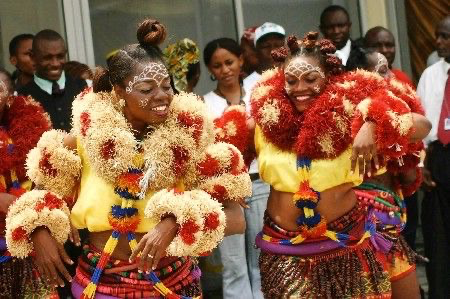
Nigeria holds more than 250 ethnic groups and, by most linguistic counts, over 500 indigenous languages. What is less often tracked is the rate at which the customs built around them are being edited down. Ten of those customs are examined below, not for what they still are, but for what is changing underneath them. None of these ten traditions has actually vanished. What they share is a pattern: the outer form often survives while the conditions that gave it daily meaning quietly fall away. Whether that counts as loss or adaptation probably depends on which generation is asked.
1. Respecting Elders
The custom itself hasn't vanished: younger Yoruba men still prostrate, women still kneel, and greetings still carry weight across most of the country's ethnic groups. What is shifting is the elder's actual function. A 1970s study of Yoruba family life by sociologist N.A. Fadipe, still cited by researchers today, traced how communal life inside the extended family began fading as young urban wives chose to live apart from their husbands' households, out of reach of the mother-in-law's daily authority. The gesture of respect has held steady; the elder's role as mediator, adviser, and household authority has migrated toward nuclear households, phone calls, and the occasional visit rather than the elder's own compound.
2. Naming Ceremonies
The eighth-day Ìsomọ lorukọ still happens across Yorùbá households, complete with honey, salt, kola nut, and alligator pepper, each item still carrying its old meaning. What's changed is scale and timing. Urban families increasingly fold the ceremony into a single afternoon squeezed between hospital discharge and a return to work, with fewer of the extended relatives who once travelled in from other towns. The symbolism has survived the ceremony's compression; the multi-day gathering it used to anchor mostly has not.
3. Traditional Marriage Rites
Practices like the Yoruba Igbeyawo and Igbo Igba Nkwu remain widely observed, often precisely because they are treated as non-negotiable ahead of a church or court wedding. But couples increasingly compress the introduction and engagement stages into one event, or hold the traditional rite only for family optics before the "real" wedding that guests actually travel for. The rite is preserved; its original weight as the marriage, rather than a preamble to one, is not always.
4. Moonlight Storytelling
Tortoise tales and cautionary lore about greed and pride still exist in Nigeria's oral memory, but the setting that once carried them — children gathered outdoors after the day's work, no screens competing for attention — has mostly disappeared from cities. Storytelling now survives mainly through deliberate effort: schools running cultural programmes, parents narrating at bedtime, or storytellers hired for cultural events. The material has outlived the informal, nightly occasion that used to deliver it for free.
5. Communal Labour
This is the tradition with the least ambiguity about its decline. Owe, the Yoruba practice of neighbours working each other's farms without pay, depended on a mostly agrarian population (as recently as 1950, close to two-thirds of Yoruba men farmed for a living). Cash-crop economics, oil-era urban migration, and the pull of salaried work in Lagos and Ibadan steadily thinned the number of people available, or willing, to show up for someone else's harvest. What remains of communal labour today survives mostly in rotating savings and credit associations and in emergency support during funerals.
6. Cultural Festivals
Festivals like Osun-Osogbo, Argungu, and the New Yam Festival remain very much alive, and in some cases larger than ever, boosted by tourism and diaspora attendance. But the shift is from lived religious or agricultural obligation toward scheduled cultural performance; a festival attended rather than a rite observed. For younger urban Nigerians, many festivals are now just something you travel home to watch rather than something the household calendar is built around.
7. Indigenous Knowledge and Traditional Skills
Weaving, blacksmithing, herbal medicine, and pottery have not disappeared, but they have moved from household necessity to specialised trade. Where indigenous knowledge was once passed down because a family needed it to farm, treat illness, or clothe itself, it now survives mainly where there is a market for authenticity (artisan cooperatives, export fabric lines, herbal medicine sold as an alternative to, rather than the default of, orthodox healthcare).
8. Indigenous Languages
This is the one with hard numbers behind it. UNESCO's Atlas of the World's Languages in Danger lists roughly 29 Nigerian languages as endangered, alongside dozens already extinct, and researchers have flagged even major languages (Yoruba, Igbo, and Ishekiri among them) as at risk over the coming decades. Nigeria's National Library has separately warned that the country's more than 500 indigenous languages face erosion as children in cities like Lagos, Abuja, and Port Harcourt grow up speaking English or Pidgin at home instead of their parents' mother tongue. Proverbs and oral wisdom tied to those languages don't translate cleanly — when the language thins, the wisdom embedded in it thins with it.
9. Traditional Clothing
Aso Oke, Isi Agu, and George wrappers haven't gone anywhere. If anything, aso ebi culture has made coordinated traditional dress more visible at weddings and funerals than it might once have been. What has disappeared is traditional clothing as ordinary, daily wear. It has become occasion-wear: pulled out for ceremonies, boxed away for the rest of the year, in a way earlier generations who wore it as everyday clothing would not recognise.
10. Hospitality
Offering a visitor water or food before any real conversation begins is still widely practiced, especially in family settings. But urban life (longer commutes, smaller apartments, tighter budgets, security concerns about strangers at the door) has narrowed who that hospitality extends to. It remains a strong norm for kin and known neighbours; it's a much thinner one for the unannounced stranger the custom was originally built to welcome.