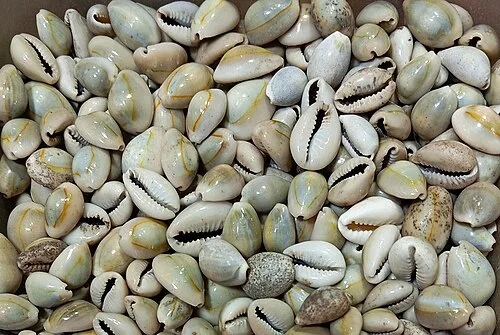
Initially a medium of exchange, every culture holds something symbolic about the cowrie shell. The cowrie shell is one of those materials that have accumulated meaning with time, rather than losing it. Among the Yoruba, the babalawo casts cowries to consult Ifa. Their open or closed faces, relaying a language only the babalawo himself, could fully access. In ancient Egypt, millions of cowries accompanied the dead into their tombs, ensuring they did not enter the afterlife empty-handed. The Akan of Ghana absorbed it so completely as a medium of exchange that when the country named its currency in 1965, they reached for the word cedi, the Akan word for cowrie. And when the cowrie touched the soil of Igboland, it underwent perhaps its most remarkable transformation. The Igbo saw in it, purpose far beyond commerce. They made it their own in every dimension of life imaginable. It became ornament and oracle, currency and cosmology, beauty and belief.
The presence of cowries in Africa can be traced back to the eighth century. They came from the warm shallows of the Indian Ocean, harvested by divers in the Maldives, and moved through the towns of North Africa before filtering south into West Africa along the trans-Saharan trade routes. There, the cowrie joined an existing economy of palm oil, cloth, iron, and — in the centuries of the Atlantic trade — human lives, as a unit of exchange so trusted that colonial governments would later struggle for decades to dislodge it.
By the time European observers began recording life in southeastern Nigeria, cowries had become woven into Igbo economic life. Bags of them measured wealth, settled debts, and fixed prices in the great markets of Eke, Orie, Afọ, and Nkwo. Ime ego, the payment that formalized a marriage and bound two families together, was measured in cowries. Without it, a union was socially unrecognized and spiritually unsealed. The cowrie shell was, in this sense, the material witness to the most important contract an Igbo family could enter.
In a society where oral agreement and market reputation formed the true backbone of commerce, a currency with the cowrie’s particular quality of being a natural object, irregular, yet nearly impossible to counterfeit, became something close to sacred trust made tangible. A man did not need to announce his wealth. It could be read at a glance, in the weight of the bag he carried to market, in the cowries that lined his wife’s waist, in the heap counted out at his daughter’s bride price negotiation. It became the primary measure by which a man’s standing in his community could be read at a glance.
The cowrie did not remain confined to the marketplace. As it circulated through transactions that marked the most significant moments of life, it accumulated meanings that exceeded its monetary value. In a society that did not sharply divide the material from the spiritual, an object so woven into human relationships could not remain “just money.” It became a vessel of power, identity, and sacred presence.
This expansion of its role reflected a central feature of Igbo thought: objects can carry ike (power). The cowrie’s whiteness connected it to nzu, the white chalk used in rituals, a colour associated with purity, blessing, and ancestral presence.
The dibia who governs Afa, the Igbo system of divination, is a highly respected figure in Igbo communities, serving as an intermediary between the physical world and the spiritual realm. In the most common form of Afa, the dibia uses a string of seed pods (obi akwara) or, in many variants, cowrie shells arranged in random sets. The dibia casts the cowries onto a flat surface, a tray, a piece of cloth, or most commonly, the bare earth, and the he interprets the pattern of their fall to the ordinary eye. What he sees is not just the physical arrangement but what it reveals about the relationship between a person seeking counsel, their chi, their ancestors, and the particular pressures of the moment they are living through. Afa is enforced by Agwu, the Igbo deity of divination and inspiration, who bestows the gift of spiritual sight on the dibia, and it is through Agwu that the cowrie becomes a mouth through which the ancestors speaks. It is through this practice that cowries became associated with the ancestral forces and spirit guides.
The cowries were In many cases, also used to ward off aggression from forces of darkness. Its features, most especially the whiteness and shape placed it in that register. In Igbo society, to wear something white was to invoke ancestral protection. Hunters sewed cowries into their charms and amulets before embarking on expeditions. Families placed it on their newborn without any elaborate ritual, just the shell positioned between the child and what might threaten them. They were also incorporated into the walls and ceilings of houses as part of the architectural design meant to ward off evil around the building.
Nothing worn on the body is accidental. Several African society, particularly the Igbos, believe beauty and meaning are not two separate categories. Stretching in from pre-colonial Igbo tradition, jewelries, clothes, hairstyle, and other forms of adornment became ways of making visible what is otherwise interior: a person’s lineage, status, spiritual standing, or life stage was mostly interpreted by what they out on. The cowrie is proof of this principle rendered in material form.
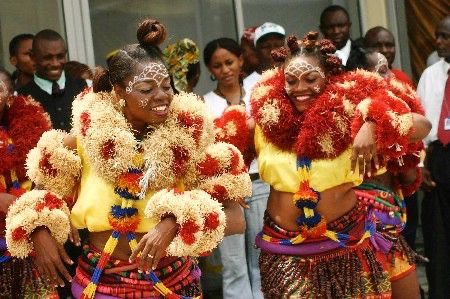
Cowrie waist beads (mgba) were worn from girlhood, their configurations changing as a woman moved through the stages of life. A young girl’s cowrie string was light, simple, a statement of emerging presence. A marriageable young woman’s beads were fuller, more elaborate, sometimes combined with coral and seed beads, announced by the deliberate sway of her walk. An elder woman who had raised children and navigated decades of Igbo life wore beads that were records
Among the most recognisable uses is on the ceremonial dress of titled men and women. Titles like ozo, lolo, mark an individual’s formal ascent through recognised stages of social and spiritual life. The cowrie appears on the regalia of the titled: sewn onto caps, incorporated into necklaces worn alongside ivory and red coral, attached to the edges of ceremonial cloth. All in the way that says: this person now belongs to a particular order of the world. Have achieved the status that comes with age, children, and community standing.
The cowrie also makes its way into masquerade, the most repelling of the Igbo personalities. Masquerade costumes across Igboland incorporated cowries as key decorative and spiritual elements. Mmanwu, as the Igbo know them are usually tied to ancestral spirits. The clicking of the cowrie shells as the masquerade moves is not incidental; sound and motion are part of how the spiritual manifests in the physical world. The cowrie here is potent.