
Palm wine is a very common, yet salient drink in African history and culture. With its roots stemming from various regions in Africa, the Caribbean, and some parts of Asia, the consumption of Palm wine has spread all over the world.
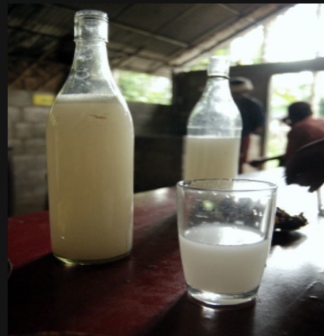
Palm wine is gotten from the sap of various species of palm trees. The flavour profile of palm wine changes from region to region. Also, each species of palm tree has a completely different taste from the other. These species include palmyra, date palms, raffia palms, oil palms, and coconut palms.
The sap is collected by a palm wine tapper, who extracts it from the palm tree. This is done by climbing the tree to extract the sap from a container fastened to the flower stump. It can also be done by felling the tree entirely to facilitate the collection of sap.

Palm wine is characterized by its distinct, sour, tangy, yet flavorful taste. It goes through a process of fermentation, which gives it that unique taste. The sap begins to ferment as soon as it leaves the tree. This process is aided by yeasts.
The basis of fermentation is a natural biochemical process. Micro-organisms, such as bacteria and yeast, break down carbohydrates, like starch and sugars, in the absence of oxygen, into alcohols and acids. These alcohols and acids act as a natural preservative for the palm wine, which gives it the distinct tangy taste. The longer the fermentation process takes, the greater the alcohol concentration of the palm wine.
Palm wine has various names across different regions and countries. In Nigeria, it is nicknamed palmy, although it still has different names according to different tribes. In Kenya, it is called mnazi, in Gambia, it is called singer, and in francophone countries in Africa, it is referred to as vin de palme. The distilled form is called sodavi and akpetashi in Benin and Ghana, respectively.
Palm wine is one of the most celebrated drinks in Africa. Beyond refreshment, it plays various roles in culture and tradition. It is used as a symbol of unity, celebration, and spirituality in many African festivals and rites of passage ceremonies. Some events like weddings, funerals, festivals, and naming ceremonies in certain regions cannot be carried out without the presence of palm wine. This shows its essential and symbolic role.
Various Roles of Palm Wine
Palm Wine in Weddings
Among the Igbo people of South-Eastern Nigeria, palm wine is referred to as ‘Mmaya Ocha,’ which means white drink. In Igbo traditional weddings, palm wine plays a very significant role. A suitor, who is seeking the hand of a lady in marriage, is required to bring palm wine to his in-laws. Various regions in Igboland have their own customs on how many gallons of palm wine are required by the suitor. Elders then bless this palm wine before it is enjoyed by the couple. This culture is similarly observed in the North-Western regions of Cameroon, which neighbor the South-Eastern part of Nigeria.
Igba Nkwu Nwayi is a significant Igbo traditional marriage rite. The bride carries palm wine in a calabash and searches for her groom, who is hidden among the guests. Once she finds him, she kneels and offers him the drink. If he accepts and drinks the palm wine, it symbolizes her consent and seals the marriage in front of the family and community.
In the traditional weddings of the Yoruba people of South-Western Nigeria, palm wine is sometimes shared in communal cups. This signifies purity of intention and the union between two families.
In Sierra Leone, palm wine is referred to as Poyo. According to one of the oldest tribes in Sierra Leone, the Limbas tribe, he who brings poyo brings life. It is served at weddings, as well as other significant events.
Palm Wine in Festivals and Harvests
Palm wine is often shared in communal gatherings in various regions in Africa after successful harvests. It is seen as a drink of abundance and thanksgiving for a prosperous harvest, as well as hope for future prosperity. In cultural festivals, such as the New Yam festival of the Igbo people, palm wine is used to commemorate the event. At this festival, the first yam is offered to the gods and ancestors. This is often accompanied by libations of palm wine. It represents gratitude to the gods and ancestors for favour. It serves as a link between success in agricultural endeavors and thanksgiving to the spirits.
Palm Wine in Naming Ceremonies
Palm wine plays a deeply significant role in naming ceremonies in many African cultures. When a child is born, the community gathers to celebrate the new life. This act shows that the community embraces the child as a member of the society. Offering palm wine at this moment is a symbolic way of welcoming the child into the lineage.
A portion of wine may be poured as a libation to the ancestors during these naming ceremonies. The elders invoke blessings, asking the departed to guide and protect the child.
Palm Wine in Funerals, Libations and Rituals
In West African traditions, palm wine is poured on the ground as an offering to the ancestors. This symbolizes a respect for the dead and marks the beginning of many palm wine drinking sessions. It is used by elders to speak to the spirit world.
The Fon people in the Republic of Benin incorporate palm wine into voodoo ceremonies. This bridges the gap between the living and the spirit world.
Palm wine is served in a cup such as an ox horn or bamboo cup, or a calabash, and offered to deities such as Ogun (The God of Iron) and Obatala (The God of Purity).
Among the Efik and Ibibio people of Southern Nigerian, palm wine is shared at Ekpe society meetings where elders use it to seal oaths and agreements.

Aside from its cultural and traditional roles, palm wine is used traditionally as an herbal medicine. It can be mixed with herbs and used to treat ailments like malaria, stomach upset, and other infections.
Palm wine is far more than a traditional beverage. It is a cultural symbol of Africa. From weddings to funerals, harvests, and celebrations, the presence of palm wine signifies unity, respect, and joy. It serves as a tool for social cohesion. It is a social equalizer that unites people from various social classes during communal drinking and gatherings. It also provides a link and a source of preservation to pre-existing culture.
Palm wine indeed remains the African champagne, a drink of celebration, connection, and life.


