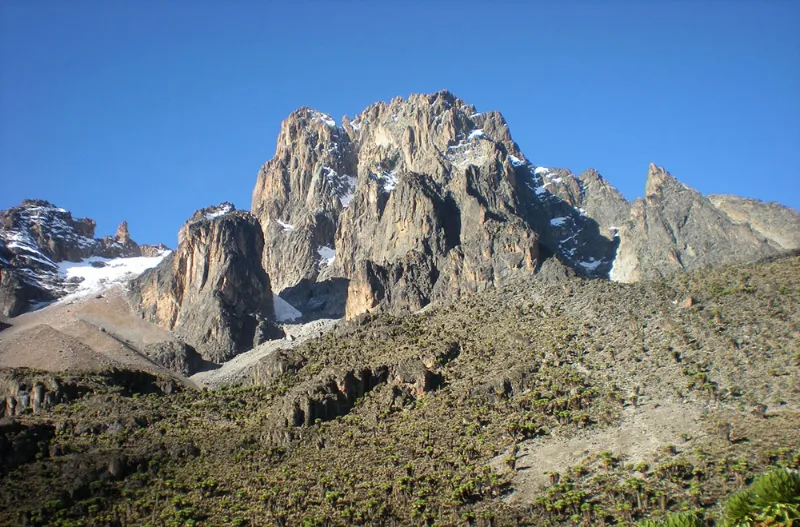
Among the Gĩkũyũ people of central Kenya — the largest ethnic group in the country, historically concentrated in the fertile highlands surrounding Mount Kenya (Kĩrĩnyaga) — the Supreme Being is known as Ngai. Unlike many African theological systems in which the divine is distributed across a pantheon of intermediary spirits, Gĩkũyũ cosmology is strikingly monotheistic in structure: Ngai is singular, supreme, and without a consort or divine family. What makes the Gĩkũyũ conception of Ngai philosophically distinctive, however, is not merely its monotheism but the way in which divine presence is localised in a specific geographical feature, and what this localisation implies for the relationship between ecology, morality, and sacred space.
Mount Kenya (Kĩrĩnyaga, meaning "mountain of whiteness" or "place of brightness") is not merely a sacred site in Gĩkũyũ cosmology. It is understood as the literal dwelling place of Ngai: the point at which the divine touches the earth. When Gĩkũyũ people pray, they traditionally face Kĩrĩnyaga. Houses in traditional Gĩkũyũ settlements were built with their doors oriented toward the mountain. At moments of great personal or communal crisis like illness, drought, or conflict, the individuals and communities turned physically toward Kĩrĩnyaga in prayer and supplication. This geographical orientation of religious practice is not unique to the Gĩkũyũ; many cultures worldwide orient sacred architecture and ritual action toward specific natural features. What is distinctive in the Gĩkũyũ case is the theological elaboration that accompanies this practice. Kĩrĩnyaga is, in a precise theological sense, Ngai's home, where Ngai rests when not moving through the world. The mountain's perpetual snow-capped peaks, visible across vast distances of the central highlands, are understood as the visible sign of divine habitation.
The ecological consequences of this theology are significant. A mountain understood as divine dwelling cannot be treated as a resource to be exploited. The forests of Kĩrĩnyaga's slopes which feed the rivers that water the highlands, were traditionally protected not by legislation but by cosmological prohibition. To cut the sacred trees of the mountain's upper reaches was an intrusion into Ngai's domestic space.
The Gĩkũyũ origin narrative, as documented by the pioneering ethnographer and Gĩkũyũ intellectual Jomo Kenyatta in his 1938 work Facing Mount Kenya, begins with Ngai summoning the first man, Gĩkũyũ, to the summit of Kĩrĩnyaga. From this vantage point, Ngai shows Gĩkũyũ the land spread out below (the forests, rivers, and plains of the central highlands) and gives it to him and his descendants. Ngai then provides Gĩkũyũ with a wife, Mũmbi ("the moulder" or "creator"), from whom the nine — sometimes ten — clans of the Gĩkũyũ people descend. This narrative is structurally a covenant: Ngai gives land, wife, and progeny; in return, the Gĩkũyũ people are expected to maintain specific obligations to honor Ngai through sacrifice, maintain the sacred groves, and govern themselves according to the principles of mũciĩ (household order) and mũhĩriga (clan responsibility).
Ngai in Gĩkũyũ theology is a moral governor. The concept of thahu (ritual pollution or moral contamination) is the mechanism through which Ngai's moral governance operates at the level of daily life. Thahu is incurred through specific acts of transgression such as contact with death or blood without proper purification, violation of sexual prohibitions, disrespect toward elders, or failure to fulfill ritual obligations. Once incurred, thahu attaches to the individual and, through the principle of moral contagion, to their household and community.
Thahu has material consequences. Illness, crop failure, infertility, and misfortune are all understood as potential manifestations of thahu (not as divine punishment in a retributive sense, but as the natural consequences of cosmological misalignment). The world, in Gĩkũyũ thought, is structured to function according to certain principles; thahu is what happens when those principles are violated, and its effects are as automatic as the effects of any other structural disruption. The remedy for thahu is gũthinjwo, a ritual purification, typically involving sacrifice, the intervention of a specialist (mũndũ mũgo), and the restoration of right relationship with Ngai and with the community.
Gĩkũyũ political organisation was traditionally non-monarchical. Unlike the centralised kingdoms of the Great Lakes region or the hierarchical chieftaincy systems of coastal East Africa, Gĩkũyũ governance was organised through an age-grade system and a council of elders (the Kiama) whose authority derived from their proximity to ancestral wisdom and, by extension, to Ngai's moral order. The Kiama's deliberations were opened with prayers to Ngai and to the ancestors. Its judgments were understood as expressions of divine moral order rather than merely human preference. The elders' authority rested on their accumulated knowledge of mũciĩ (the principles of right household and community order) and on their ritual status as men who had passed through all the age grades and were therefore closest in the life cycle to the ancestors and to Ngai.
This integration of political and ritual authority is a recurring feature of African governance systems that colonial administrations systematically misunderstood. British colonial officers, encountering the Kiama, frequently dismissed it as an informal gathering of old men rather than recognising it as a sophisticated instrument of cosmologically grounded governance. The forced transformation of Gĩkũyũ land tenure under the Crown Lands Ordinance of 1915 (which declared "waste and unoccupied" lands the property of the Crown, effectively dispossessing Gĩkũyũ communities of land they understood as covenanted to them by Ngai) was therefore experienced as a cosmological rupture: a violation of the original covenant between Ngai and the first Gĩkũyũ.