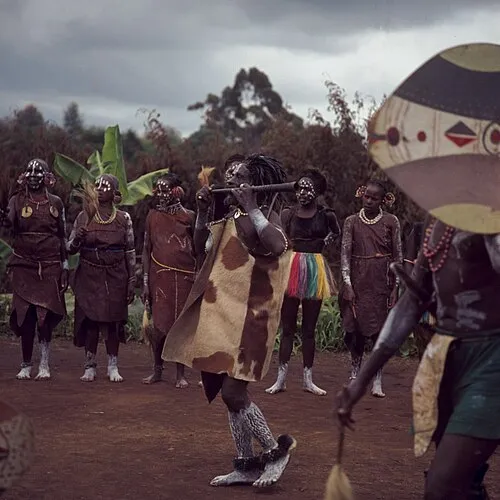
The role of food in Kenyan culture goes far beyond simple sustenance; it is a foundational institution of social interaction and community cohesion. The popular adage, "A family that eats together stays together," is a testament to this, encapsulating the warmth and strength of familial bonds in both nuclear and extended family structures. This sentiment is mirrored in the principles of Kenyan hospitality, where the act of sharing a meal is an ultimate expression of welcome and a symbol of connection, care, and community. Signature dishes like nyama choma, or roasted meat, and staples like ugali are typically served in a communal fashion, creating a space for conversation, laughter, and bonding.
This cultural precedent is further articulated in proverbs that use food as a metaphor for social dynamics. The Kuria proverb, “One person is a thin porridge; two or three people are a lump of ugali”, illustrates the weakness of isolation and the strength derived from unity.
Ugali, a stiff cooked cornmeal, symbolizes the firm, solid nature of a community bound by shared purpose. This pre-existing cultural framework, where food serves as a social language, suggests that its use in funerary rites is not a new or isolated practice but a logical and intentional extension of established social norms. The feasting at a funeral, therefore, leverages this deeply ingrained symbolic vocabulary to communicate and reinforce unity at a time of maximum social stress and fragmentation.
Central to Kenyan mourning rituals is the philosophical belief in a continuous relationship between the living and the deceased. In many communities, including the Maragoli sub-group of the Luhya, the deceased are considered the “living dead” who remain as active, though unseen, members of the community, capable of returning to share meals with their families symbolically. This perspective necessitates a careful and respectful approach to mourning, as the living are obligated to follow proper burial practices to avoid offending the departed, an act believed to bring suffering and misfortune to the living.
The Mijikenda people, for instance, believe that the ancestors’ absence can lead to calamities, and the deceased are capable of communicating their need for final rites through strange incidents, such as swarms of bees or unexplained illnesses. This worldview reveals that the spiritual purpose of funerary feasting is not merely to pacify a ghost but to actively maintain a reciprocal and ongoing relationship. The shared meal becomes a tangible medium for the living to fulfill their obligation, demonstrate respect, and, in turn, receive blessings and protection from the ancestors, thereby ensuring the community’s spiritual well-being and preventing social and cosmic disorder.
Feasting as a Mechanism of Repair
A death in a community represents a significant disruption to its social fabric, creating an emotional and social vacuum. Funerary feasting rituals serve as a deliberate, culturally engineered intervention to mitigate this disruption. The act of communal cooking and eating brings people together, fostering dialogue and mending social ties that may have been damaged by conflict or everyday life. A study on the Luhya people found that participation in these rituals helped bereaved individuals process their grief more healthily, as the rituals facilitated communication, emotional expression, and community cohesion.
This communal process provides direct psychological relief, demonstrating a clear causal chain: social disruption leads to ritualized communal eating, which in turn facilitates social reintegration and dialogue, ultimately resulting in enhanced well-being and grief processing. The shared plate forces interaction, directly countering the isolation and withdrawal often associated with individual sorrow.
The feasting ritual is not simply a passive gathering but an active mechanism for promoting prosocial behavior and reinforcing a more cooperative community. A study on the Luhya community explicitly outlined a pathway in which participation in mourning rituals enhances subjective well-being, which subsequently leads to increased prosociality. The study found a strong correlation between ritual participation and higher mean prosociality scores, indicating that these communal acts boost cooperation and mutual support.
In a moment of collective vulnerability, the ritual funnels energy into actions that benefit the entire group, such as cooperation and mutual aid. The shared food acts as the tangible vehicle through which this prosociality is expressed and consumed, solidifying the community bonds and reinforcing a sense of shared responsibility.
Food, Status, and Social Debt
.jpg)
The quantity and quality of food offered at a funeral feast establish a symbolic economy of mourning that reinforces social status and creates a system of communal obligation and reciprocity. Among the Bangangté people, for example, the success of a funeral is measured by the generosity of the feast. Similarly, the death of a titled man or elder in Kenyan communities is marked by the slaughter of many cows, goats, and chickens as a sign of honor and respect for the deceased.
This generous provision of food is not only about feeding people but a public display of the family’s standing and an extension of respect to the community. This system of gifts and reciprocal gifts seals the bonds between involved parties and creates a form of social debt. The community’s presence and reciprocal gifts support during the ritual are a form of payment, and the promise of future participation in similar rituals reinforces this ongoing cycle of obligation and gratitude. The feasting ritual thus transforms a moment of loss into a complex transaction that reinforces the social hierarchy and binds the community through a shared economy of mutual support.
- The Cow Sacrifice: The act of slaughtering a cow for a funeral, described as a symbol of resting the dead spirit in peace, is a multi-purpose ritual that serves as both a tangible offering to the deceased and a symbolic transfer of spiritual energy to the living. The sacrifice is not an end in itself but a foundational requirement for a series of rituals. Among the Mijikenda, for example, the carving of a kigango, a statue that serves as a physical dwelling for ancestral spirits, requires the family to provide two cows, a ram, and cocks of every color. This suggests the animal is a transactional medium that unlocks the next stage of the mourning process.
The subsequent consumption of the meat transforms the sacrifice from a purely spiritual offering into a communal act of spiritual communion. By ingesting the meat, the community symbolically shares in the blessings and peace of the offering, strengthening their bond with the ancestors. This consumption completes a crucial cause-and-effect relationship: a physical sacrifice leads to a spiritual blessing, which is then shared and consumed by the community, resulting in communal spiritual rejuvenation.
Specific Rituals for Unnatural Deaths
.jpg)
The manner in which a person dies is a critical determinant of their funeral rituals, particularly concerning unnatural deaths. This distinction reveals that the feasting ritual is fundamentally about reasserting moral and cosmic order, not just mourning. For suicide victims, the community views the act as an abomination. Consequently, rituals of shaming are performed, such as beating the corpse, and the burial is conducted at night, without ceremony. The body is deliberately handled disrespectfully, and the grave is flattened to ensure the person is forgotten as quickly as possible.
The absence of feasting and proper ceremony in these cases provides a crucial negative example. It demonstrates that the shared plate of mourning is not an automatic ritual but a conditional one, a public reward for a life lived within the community’s moral boundaries. The lack of a proper burial and feast is a public condemnation that denies the deceased their peaceful transition and communal communion. Thus, the feasting ritual is an act of both social repair and moral judgment, reaffirming the community's core values in the face of a violation.
Tradition and Westernization
The viability of these traditional mourning rituals is increasingly challenged by external forces such as missionization, globalization, and Westernization. A silent conflict exists between cultural practices and Christian faith, where many individuals attempt to reconcile both belief systems. This negotiation is evident in the differing viewpoints from religious and cultural leaders, as well as the Western biomedical approach to mental well-being. For example, some clergy view the slaughtering of animals not as a spiritual requirement but simply as a practical opportunity for the community to eat. This re-framing of the ritual’s function allows it to persist under a new, less spiritual guise. A generational divide also exists, with younger individuals sometimes associating practices like the kigango with witchcraft and considering them outdated. This tension highlights a cultural negotiation where communities selectively adapt or abandon practices based on their perceived relevance and economic feasibility. The economic burden of providing large feasts, as seen in other cultures with similar practices, serves as a significant practical pressure point that may accelerate these cultural shifts.
Conclusion
The shared plate of mourning is a complex cultural technology that operates on multiple levels to ensure the resilience and continuity of the community. Feasting rituals in Kenyan cultures, particularly among the Luhya and Mijikenda, are foundational pillars that allow the living to confront the finality of death by reinforcing their collective identity, restoring social order, and maintaining a vital link with the spiritual world.
The enduring power of these practices lies in their ability to leverage a pre-existing cultural language of food to meet the community's profound social, psychological, and spiritual needs. The shared plate of mourning is, therefore, a dynamic and essential framework for grief, community, and the human condition.