The first time I heard the Oja, a locally made Igbo flute, I couldn't move.
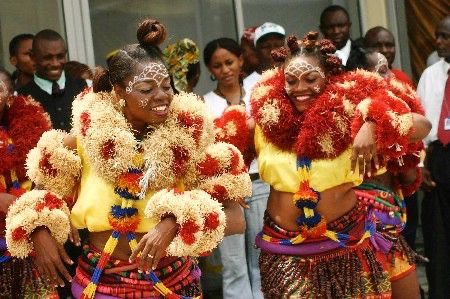
It was a Friday afternoon near the end of our stay on the NYSC orientation camp, during a cultural festival. I had nothing assigned to do, so I was wandering the parade ground the way everyone does on a free day: half paying attention, mostly just killing time. Then, a sound cut through the air, and everything else in my field of attention seemed to fall away at once. It is a strange, disorienting thing to have happen to you, and hard to explain after the fact.
My first reaction was dismissive: a local sound, I thought, too archaic to hold my attention. But as I turned toward it, the sound seemed to clarify. I stood still, watching the instrumentalist move barefoot across the dry, grassy ground, unbothered by the stones underfoot, his elbow jutting out and his fingers working the small wooden instrument with practised precision. Around me, hundreds of corps members were talking and laughing, moving about in the ordinary chaos of a free afternoon. I stood frozen in my white shirt and shorts, green jacket over the top, until the final note faded and I was, quite suddenly, shaken back into myself. Startled by the intensity of my own reaction, I walked off quickly, trying to work out what had just happened.
My first instinct was to blame flow psychology — the state in which a performer becomes so immersed in what they are doing that it moves an audience to tears almost involuntarily. I remembered an article by Dr Paul McCarthy on the concept, built on the work of Hungarian-American psychologist Mihaly Csikszentmihalyi, who described flow as an optimal state of consciousness in which self-consciousness disappears, focus becomes total, and the activity itself becomes its own reward. Neurochemically, the prefrontal cortex quiets down, dopamine rises, and the locus coeruleus releases norepinephrine to regulate arousal and attention, producing exactly the kind of heightened alertness I had felt. It seemed reasonable to conclude the performer had entered that state, and that his focus had simply radiated outward and pulled me in with it.
But the explanation felt incomplete. Flow theory can account for what happens inside a performer; it does not explain why a specific, unfamiliar sound would reach an audience member who, by most measures, should not have been receptive to it. I have always leaned toward modern instrumentation. (I barely listen to Afrobeats stars like Davido, Ayra Starr, or Burna Boy, let alone anything more traditional.) To an untrained ear, the Oja's high, piercing register can even read as harsh. So why did my body respond to this particular instrument as something so resonant?
That question sent me down a research trail. Ejiofor and Chioma have written that music functions as a vehicle for feeling, whether the listener registers it consciously or not, which pointed me toward something I had not known: within Igbo culture, the Oja was originally regarded as a mystical instrument, said to carry spiritual power strong enough to raise the dead. Enyi et al., cited in Promise Ebube's Oja: More than a musical instrument or just superstition?, describe the Oja as potentially the soul of Igbo culture itself, while Onyekwelu, cited in the same work, argues that the instrument operates in both the physical and spiritual worlds at once.
Still, for something credited with that much metaphysical weight, its actual pull on me turned out to be tied to something more linguistic than mystical: speech surrogacy, an instrument's capacity to imitate human speech. The Oja is known specifically for emulating a high-pitched, female register of speech, and researchers like Durojaye et al. have shown that our perception of it depends on its precise manipulation of pitch, timbre, and timing to mirror the Igbo dialect it's built to echo. That's the core mechanism behind most non-vocal instruments of this kind, but... the same research suggests a listener's ability to decode that musical language depends heavily on prior exposure. That finding briefly deflated my theory. I don't remember ever hearing the Oja before that day. I had even heard KCee's "Ojapiano," a song built around a synthesised version of the instrument, playing on loop throughout the festival without it once catching my attention the way the live performance did.
Udofia, also cited in Ebube's work, argues that if vocal music carries messages, instrumental music carries them too. That raised an uncomfortable question: if the Oja was speaking a literal language that afternoon, had I simply missed the message? Or had something been lost on the instrumentalist's end: a modern performance replicating an old pattern without carrying its original meaning forward, the way so many traditions now survive only in fragments of their former selves?
For a moment, doubt crept back in. It felt almost embarrassing that a twenty-first-century youth corps member was trying to manufacture a profound ancestral connection to a piece of carved Iroko, Ukpo, or camwood. But reading further shifted that. Ugochukwu and Akintunde, also cited in Ebube's work, describe the Oja player's primary role during masquerade performances as leading rhythm, chant, and praise-singing, summarised in the line: as the whistle talks, the drummers drum and the dancers dance. Read that way, the Oja might not have been transmitting ancestral wisdom that afternoon at all. It might simply have been singing praise, the way it was built to.
Onyekwelu separately describes the professional Oja player as a kind of poet, someone whose skill lies in a deep repertoire of melodic phrases drawn from Igbo musical tradition, while Ugochukwu and Akintunde frame the instrument's core function as chanting, praise-singing, and eulogy.
In the end, I stopped trying to justify the moment through academic papers. The research was worth doing; it introduced me to the real complexity of speech surrogacy, its place in Igbo culture, and the layered history behind an instrument I'd almost dismissed outright. But the raw sensation of that afternoon never needed permission from cognitive science to be real. Once I let go of the need to explain it, I could just listen to what came out of that small instrument, and let it capture me again.