So, you know how when you’re a kid, you read stuff just for fun? No subtext, no deeper meaning, just “haha, the spider got what was coming to him” and you move on with your day? Well, Tales of an Ashanti Father by Peggy Appiah was exactly that for a lot of kids growing up. Then you grow up, develop a pesky sense of history, and suddenly those same stories start looking suspiciously like they're trying to teach you something… extra.
Peggy Appiah started life as Enid Margaret Cripps, which doesn't sound like the name of someone who grew up to become Ghana's favorite British folklorist. She was the daughter of Sir Stafford Cripps, Britain's Chancellor of the Exchequer, went to secretarial college, and worked in Moscow, Tehran, and for Britain's Ministry of Information.
Then in 1953, she fell in love and married Joe Appiah, a Ghanaian lawyer, statesman, and Ashanti aristocrat. And let me tell you, this caused a stir. South Africa’s minister of justice called it “disgusting,” a newspaper in Northern Rhodesia claimed that the photographs would “turn the stomach of a pig,” which, in retrospect, must’ve been quite the mental image. Joe Appiah was the London representative for Kwame Nkrumah, who was about to become Ghana’s first prime minister, a black man to boot. Their romance was rumored to have inspired Guess Who's Coming to Dinner?, since Hollywood apparently couldn't invent interracial romance without borrowing from real life.
She moved to Kumasi in 1954, stayed for over fifty years, learned Asante Twi, and spent her time writing down stories she heard from people around her. She was basically doing a one-woman preservation project during a time when everything was changing rapidly. One result of all this was Tales of an Ashanti Father, published in 1967, a collection of twenty-two anansesem, spider stories, from Akan oral tradition.
And these stories aren’t exactly what you'd call nuanced. Ashanti folklore doesn't do subtext the way Western literature does. There’s no "well, what the author really meant was…” No, these stories tell you exactly what happens when you mess up. Respect your elders, do your share of the work, don’t lie to your king, and don’t assume nature owes you anything just because it gave you something once. Oh, and they tell you all this through animals so nobody has to get too offended on the way to the lesson.
But you see, Peggy Appiah was writing at a time when Ghana was busy tearing down the old colonial school system and building a new one, which meant oral traditions were in real danger of being treated like embarrassing childhood hobbies rather than priceless cultural artifacts. Fortunately, the anansesem didn't get that memo. They packed their bags and hit the high seas anyway. That same crafty spider shows up as Anansi in the Caribbean, and his whole “brains over brawn” routine pops up again in figures like Br’er Rabbit and Aunt Nancy in the American South, because if you’re enslaved and surrounded by people with all the physical power, dreaming up ways to outwit them is far more satisfying than a fistfight.
Now across all twenty-two stories, the real concern isn't who can throw a punch, but who's paying attention, who has the guts to tell a king he's wrong, who actually turns up to help with the communal chores, and, inevitably, who gets caught red-handed.
Let's talk about the politics of power. The Ashanti kingdom's political system wasn't one for messing around. The Ohene (king) had absolute power over life and death. In The Hunter and the Tortoise, a hunter falsely claims his tortoise can sing, and the king just... kills him. No trial, no appeals, just “off with his head” and that’s that. Very efficient, if a bit harsh. But it gets more interesting when you realize that even if every chief could execute subjects for bad performances, their power still had limits. The Council of Elders and public opinion could check that authority. And you see this in The Left-handed King and The Bitter Pill.
In The Left-handed King, King Kwadwo decides everyone in his kingdom should eat with their left hands. Why? Because a neighboring ruler does it and seems more prosperous. Nobody questions this brilliant logic until an elder finally pipes up with, “You know that other king only eats left-handed because a lion mauled his right arm years ago, right?” Once the truth comes out, the Council of Elders immediately removes Kwadwo from power. All of this is actually based on a real Ashanti political mechanism called destoolment, which is basically a formal firing process for chiefs who govern badly or refuse to consult their councils.
Then there’s The Bitter Pill, where a king serves his cabinet some spoiled, bitter wine and watches what they say. Ten councillors praise the drink to stay in his good graces, sycophants, the lot of them, and only the eleventh tells him the truth: “It's odae.” Undrinkable, basically poison and that honest man gets promoted while the flatterers get executed. The phrase “Odae, Odae, the bitter, bitter pill.” became a cultural critique of sycophancy and bad governance.
The lesson of these stories? Surround yourself with people who lie to keep you comfortable, and you’ll eventually drink the poison yourself. Pretty solid advice for anyone running anything, honestly.
Now we get into the family drama. In Akan society, descent is traced through the female line. The maternal clan, abusua, is where it’s at. A child inherits the father’s ntoro (spirit) but the mother’s mogya (flesh and blood) , which binds them more closely to the mother’s clan.
Why Nephews Inherit Property in Ashanti is basically a folktale version of this legal explanation. A man named Kwaku Amponsa loses his crops, can’t pay his debts, and faces enslavement. His wife and children refuse to work off the debt, but his sister immediately offers up her own son as a laborer to save him. Amponsa responds by leaving his estate to that nephew instead of his own children.
Now, this might seem odd to modern sensibilities, but in Akan inheritance law, it makes perfect sense. Marriage was treated as an alliance between two families, not a full merger. So a wife’s obligations to her husband’s debts were limited. A father has no legal authority over his children as well, he can’t make them live with him or claim custody if he divorces their mother. But a sister’s obligations to her brother were absolute, because they belonged to the same maternal clan.
The story goes beyond gratitude, though. It teaches children that their primary duties of loyalty and financial safety are tied to their maternal lineage. All dressed up as a folktale so kids can repeat the reasoning back without needing a law degree.
But then, taking a closer look at the tales reveals a more complex picture of gender. Women are either cast as instruments of their brothers’ and sons’ welfare rather than independent agents or unlikable and prideful through the tales.
The sister in Why Nephews Inherit Property in Ashanti acts with selfless loyalty, modeling the ideal of female solidarity within the abusua. But in Abena and the Python, Abena who rejects every local suitor, because how dare she have standards? Ends up married to a python in disguise, isolated from her community and transformed into an old hag. The moral here? Women who exercise too much choice in marriage partners endanger themselves and their communities.
Meanwhile, male characters like Ananse are punished for greed and arrogance but rarely for sexual or romantic transgressions. Their comeuppance is usually physical (narrowed waist, baldness, sores) rather than social isolation. Because of course.
In Ashanti forest communities, they relied on nnoboa, a system of collective work where everyone had to show up to clear and plant fields.
Why the Snake has no Legs is basically the folktale version of a workplace complaint about someone who never pulls their weight. The animals set up a communal farm. Snake, wily and full-limbed, avoids every stage of the work, sits in the trees criticizing everyone else’s technique instead of picking up a hoe. Then when the crops come in, Snake steals them and gets caught in a tar trap set by Ananse. His punishment? A painful and mildly horrific process of disentanglement which causes him to his limbs entirely.
It’s a fairly severe HR outcome for skipping a few shifts, but the point still lands. Contributing nothing while eating from shared resources was treated less as a minor social offense and more as an attack on the whole system everyone depended on to eat.
A related point is also made from the other direction in Kwaku Ananse and the Donkey, when Ananse convinces Donkey to work his farms for him while he goes off, marries, and gets rich, leaving Donkey with nothing to show for the labor. Whereas the Snake story punishes the freeloader, the Donkey story rewards the exploiter. Between the two of them, they cover most of the ways a farming partnership can go wrong.
A handful of other tales handle property and trust a bit more directly. Why the Lizard Stretches his Neck, Lizard betrays Ananse, keeps a chief’s daughter’s secret name for himself, and spends his life stretching his neck out in nervous paranoia over getting caught. Why the Crow Chases the Hen is a property dispute over a borrowed needle that Hen loses, and the chase never ends. Why the Lion Roars and The Old Man and the Mouse both let small, unimpressive characters outmaneuver bigger ones, whether it’s Rat stealing a lion’s palm kernels during a famine or a mouse negotiating through cows and masons to get his tail back.
Ananse is the trickiest character to pin down (pun absolutely intended). The stories don’t let him stay a hero or a villain for too long. He’s small and physically outmatched by python, leopard, and lion, so wit is his only real weapon.
How Kwaku Ananse Won a Kingdom with a Grain of Corn shows the trickster at his best, from trading up from a single seed to a chicken, a sheep, a cow, and eventually an entire kingdom through nothing but nerve and negotiation. But in the end, greed always catches up with him. His daughter dies after he gives her to a hunter (death) for meat, his waist got pinched thin after Nyame threw a pot at him for deceiving Python. His baldness comes from boiling palm oil poured on his head as punishment for stealing cassava. His habit of hiding in ceiling corners is just shame with nowhere else to go. Every physical trait gets an origin story rooted in some past bad decision, a fairly efficient way to teach cause and effect to a child without a single lecture involved.
Still none of this makes him a villain, exactly. He’s less a moral category than a stand-in for appetite itself, the part of anyone that wants to win without doing the work, and gets away with it just often enough to keep trying. That’s probably why the same spider can get strung up one week and handed a kingdom the next without the stories feeling inconsistent about it.
A question arises after reading Tales of an Ashanti Father.
Truly, the twenty-two tales was aimed at children, but which children? Published in London by Andre Deutsch, it reached both Ghanaian and international audiences. For Ghanaian children in the 1960s, it offered stories in English that affirmed their cultural heritage at a moment of national identity formation. For international readers, it provided a window into West African oral tradition. Appiah’s work bridged two audiences, a feat that required careful negotiation between cultural authenticity and accessibility.
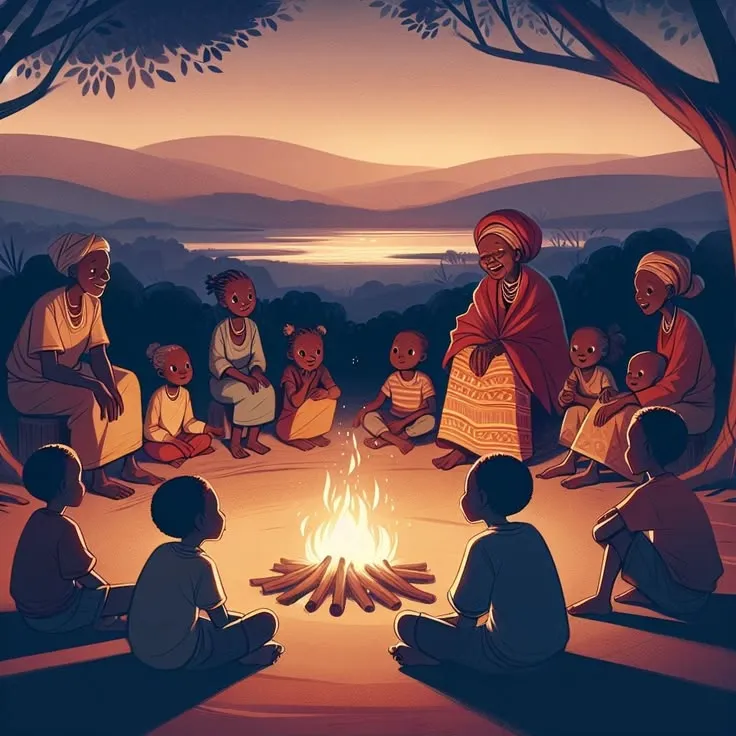
But the thing is, during oral storytelling, the usual barriers that separate sexes, classes, and age groups break down. Both women and men narrate tales, children listen eagerly. The morals are formulated and affirmed by the audience. In the oral context, women are active participants in shaping and interpreting the stories. Appiah’s written collection, while preserving the narratives, loses this participatory dimension, potentially flattening the gender and social dynamics that emerge in live performance. So we’re getting a snapshot, not the full picture.
Still, the book’s legacy extended beyond its initial publication. Appiah went on to produce a stream of illustrated books retelling Ashanti stories through the 1960s and beyond: Ananse the Spider (1966), The Children of Ananse (1968), Why There Are So Many Roads (1972), and Why the Hyena Does Not Care for Fish and Other Tales from the Ashanti Gold Weights (1977). She was appointed MBE in 1996 for services to UK-Ghanaian relations, and stayed in Kumasi, still collecting and writing, until her death there in 2006.
Reading these stories as a bored child had obvious appeal, there's talking animals, tidy punishments, a spider who somehow keeps winning and losing in the same story. Read again as an adult, there's an abundance of explanation on a people’s economic and social structure.
But the stories do more than explain social structures. They reveal the tensions inside those structures, between individual ambition and communal obligation, between absolute power and its limits, between the oral tradition’s communal richness and the fixed permanence of the written page.
They raise questions about who gets to tell a people’s stories, in what language, and for whom. And they remind us that the tales collected by a British woman in 1960s Ghana were never just children’s entertainment. They were, and still are, living documents of a society’s deepest values, encoded in the adventures of a spider who just can’t stop getting caught.