

An Innovation Older Than Farming
When we think about ancient African innovations, our minds often jump to pyramids, iron smelting, or medieval learning centers like Timbuktu.
But there is a quieter, humbler invention that completely transformed human survival — pottery. Around 9,400 BCE, communities in what is now West Africa began shaping earth and water into one of humanity’s most transformative inventions.
At Ounjougou, an archaeological site along the Bandiagara Escarpment in present-day Mali, archaeologists uncovered ceramic fragments dating back to over 11,000 years, marking pottery as a foundational technology in sub-Saharan Africa. The pots were handmade, low-fired, and decorated with simple impressions, often made by pressing plant fibers or tools into the wet clay.
These are not just the oldest known ceramics in West Africa — they are among the earliest in the world, rivaling those from East Asia. What makes them extraordinary is when they appeared: not during an age of farming or city life, but while people were still living as hunter-gatherers.
The World of 9,500 BCE
Back then, West Africa was in the middle of a “Green Sahara” phase. Grasslands stretched far across areas we now see as desert. Rainfall was plentiful, rivers flowed, and wild grains like millet grew in abundance.
The people of Ounjougou were mobile foragers, skilled at tracking game, collecting edible plants, and harvesting wild cereals. But the appearance of pottery in this context suggests a shift in how they processed and stored food.
Why Pottery Was Revolutionary
Pottery represented a technological leap that fundamentally reshaped daily life. Before pottery, cooking involved roasting food on open fires or using animal skins to heat water with hot stones. These methods were limited in what they could prepare.
With clay vessels, everything changed:
- Cooking Efficiency – Pots made it easier to boil, steam, or slow-cook food. Pottery allowed them to soften wild millet and yams, making them more digestible and increasing nutrition.
- Food Storage – Dried seeds, grains, and nuts could now be stored in containers and kept for longer periods, protecting them from pests and humidity.
- Mobility & Trade – Lightweight yet durable containers made it possible to transport goods more efficiently.
- Cultural Expression – Even the earliest shards from Ounjougou bear decorative impressions, suggesting that pottery was not only practical but also symbolic, reflecting social identity and artistry.
How This Shaped Society
The invention of pottery nudged Ounjougou communities toward greater semi-sedentary living. While they were still hunter-gatherers, the ability to store surplus food meant they could remain in one place for longer periods. This stability encouraged:
- Population growth – More reliable food supplies supported larger groups.
- Technological diversification – Freed from constant movement, people could specialize in crafts like toolmaking, weaving, and advanced pottery decoration.
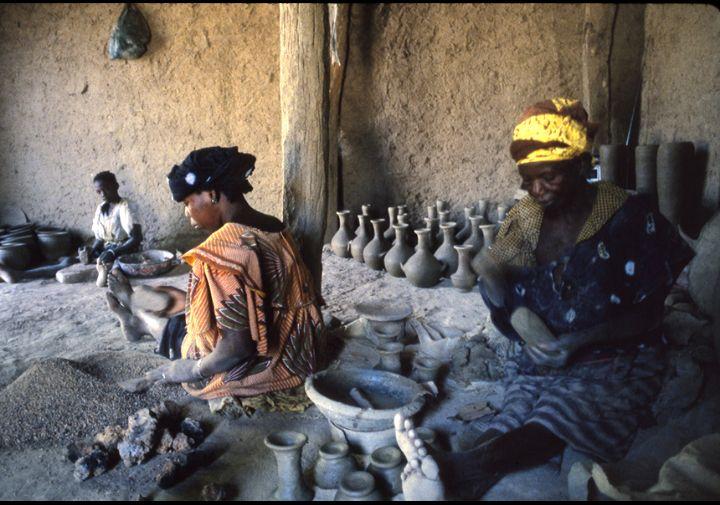
- Knowledge transmission - Pottery-making skills, often passed down through women, became part of a cultural heritage that strengthened community bonds.
Influence on Later Civilizations
Over thousands of years, the pottery traditions at Ounjougou evolved and spread across West Africa. As agriculture began to take root, pottery became essential for processing and storing crops like millet and sorghum.
Pottery workshops likely became centers of specialized knowledge, with skills passed down through generations—especially among women, who in many African societies were the primary potters.
The innovations of these early potters laid the groundwork for millennia of West African ceramic traditions. They became the foundation for later artistic and technological developments, influencing the bold geometric designs of Nok culture (Nigeria, ca. 1000 BCE) – famous for terracotta sculpture, the medieval Mali Empire – where pottery facilitated trade and daily urban life, and modern craft traditions – where techniques such as coiling and burnishing are still practiced.
In other words, Ounjougou’s ceramics are not just archaeological artifacts — they are the ancestors of an unbroken cultural lineage.
A Legacy in Clay
Today, holding an 11,000-year-old shard from Ounjougou is like shaking hands with a person from deep prehistory. Each groove and curve tells a story — of survival, adaptation, and creativity.
Pottery was more than a container. It was a container of ideas — ideas that shaped how West Africans ate, lived, and related to their environment. Without this innovation, the path to agriculture, permanent settlements, and eventually great civilizations might have looked very different.


