To observe a gathering of Igbo men today, whether at a traditional marriage, a political summit, or a diaspora convention, is to behold a sea of roaring heads woven into thick, plush velvet. It is the Isi-Agu, which has become universally accepted as the unmistakable, authentic uniform of the Igbo man.
To understand the Isi-Agu, we must confront a zoological and linguistic paradox. In indigenous Igbo cosmology, the ultimate apex predator is the Leopard (Agụ). The Lion is known as Ọdụm. Why, then, does the national attire feature the head of a Lion, yet the people stubbornly name it Isi-Agụ (Head of the Leopard) The answer lies in the aggressive economics of Victorian-era trade. Driven by the demand for palm oil and a myriad of other raw materials, European merchants introduced many incentives. Among these were heavy, manufactured velvets which were sent to the West African coast. These fabrics, rolling out of British and Dutch mills, were printed with the heraldic English Lion which is a symbol of European imperial royalty.
Looking at the historical trajectory of this fabric, the reaction of the Igbo elite can arguably be understood as a brilliant sociological maneuver known as Indigenization. Within this framework, a local community takes a foreign artifact, strips it of its original imperial context, and rewrites its meaning to fit their indigenous realities. By adopting the prestigious textile while retaining the name Isi-Agu, it appears they linguistically stripped the British lion of its intent, symbolically baptizing it with the spirit of their own indigenous predator. From this, we can infer a profound cultural subversion: a foreign lion was imported, but a localized leopard was worn.
This phenomenon is not unique to the Igbo. Across the continent, Africans have historically weaponised colonial imports for their own cultural assertion. The Herero women of Namibia famously adopted the heavy, floor-length Victorian dresses of their German colonisers (the Ohorokova) and indigenised them. What was once the dress code of the oppressor was transformed over generations into an unyielding symbol of Herero ethnic pride and anti-colonial survival.
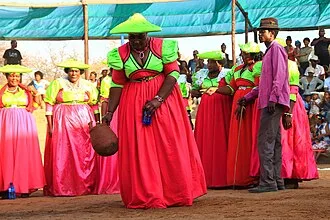
Herero women dressed in Ohorokova [Photo Credit: SanDanceVR, via Wikimedia Commons]
For the Igbo, this adoption may have been accelerated by the limitations of local textile manufacturing. As documented by early observers like Olaudah Equiano and G.T. Basden, pre-colonial Igbo societies possessed rich, environmentally conscious clothing traditions. However, the indigenous Akwete cloth, though structurally magnificent, was hand-woven and painfully slow to mass-produce.
A fabric alone, however, does not constitute a cultural uniform. It requires a codified visual hierarchy to enforce its authority. To achieve this, the Igbo elite likely functioned as what French anthropologist Claude Lévi-Strauss termed bricoleurs (architects who construct new cultural realities by tinkering with a diverse array of available, seemingly unrelated materials). This process is known as Cultural Bricolage. The imported velvet was integrated into the aristocracy by merging it with other symbols of authority, most notably the traditional red cap. The red caps worn by chiefs were reportedly introduced by Obi Okosi of Onitsha, who reigned from 1901 to 1931, to differentiate the members of the native courts and title holders from ordinary citizens. The term used is okpu ododo, with "ododo" originating as a Bini word meaning red.
When put together—the Victorian velvet lion, the red cap, and the Indian George wrapper accessorised with coral beads, the ofo, etc.—the attire became an exclusive preserve. Historically, wearing the Isi-agu attire was restricted to only the titled Chiefs. It operated as a garment that announces itself in dazzling sparkles without requiring conventional explanation. It became a visible symbol signaling gender, social status, and political office. The sociological arrangement here was tied to prestige over practicality. Deliberately choosing to wear thick, sweltering European velvet in the brutal tropical heat was the ultimate exhibition of wealth. It announced that the wearer's economic reach extended to the oceans, projecting high social status and political power.
In 1983, historians Eric Hobsbawm and Terence Ranger coined the term "The Invention of Tradition" to describe how cultural practices perceived as ancient are often quite recent, deliberately constructed to establish social cohesion. The Isi-Agu fits this framework perfectly. The Isi-Agu belongs to the same family of invented traditions and cultural adoptions as the Swahili Kanga (which evolved from unstitched Portuguese handkerchiefs) or Austrian and Swiss "Lace" or even the Indian Madras, known locally as the George fabric. However, what sets the Isi-Agu apart is its highly specific, unmistakably iconic visual identity. Given its unmistakable visual weight, one can deduce why public Igbo figures, wealthy merchants, and political elites increasingly gravitated toward the Isi-Agu as their definitive public look. This apparent top-down adoption arguably acted as a catalyst, exponentially increasing the fabric’s prestige. Consequently, this elite endorsement likely drove up its cost per yard, ultimately cementing its modern perception as an intrinsically 'Igbo' uniform.
Some cultural commentators and historians report that the attire gained further ideological momentum in the early 1970s. According to Madukasi (2018), a Nigerian Catholic priest from Ekwuluobia, Monsignor Martin Maduka, is regarded by some as a pioneer who Africanized the church by preaching that Africans did not have to wear Western priestly garments. He opted instead to wear local attire to prove that indigenous culture and the church were not mutually antagonistic.

Dim Chukwuemeka Odumegwu Ojukwu in Isi-Agu outfit [Photot Credit: PM News]
Though Msgr. Maduka’s theological rebellion is a fascinating footnote, one could infer that his influence simply rode the wave of an existing cultural shift. The consolidation of the Isi-Agu as a pan-Igbo emblem was arguably finalized by the political elite. The public endorsement by historical titans like Dim Chukwuemeka Odumegwu Ojukwu, alongside modern leaders like David Umahi, transformed the velvet into a visual manifesto. Therefore, its mainstream dominance appears less rooted in religious Africanisation, and more in its undeniable aesthetic power and its aggressive adoption by the ruling class.
Despite its wider democratisation after the Nigerian Civil War, the Isi-Agu has never lost its gravity. It remains deeply ceremonial. The regalia must be worn correctly and must not be worn profanely. It is actively reserved for sacred events of continuity, traditional marriages, and high-stakes convocations. It also remains a potent class symbol. The fabric is quite expensive per yard to acquire, operating as a conscious, costly investment in identity.
Today, the evolution of the Isi-Agu continues aggressively. The classic velvet now comes in diverse colours to assume or reflect the growth in taste among the Igbo people. More importantly, the zoology of the fabric has expanded. Modern iterations frequently deviate from the traditional lion, featuring new patterns that include the leopard (agu), antelope (ele), deer, dogs, horses, and an array of purely aesthetic, abstract geometric designs.
References
https://dismantlemag.com/2022/08/01/ohorokova-dress-herero-beauty-memory/
https://okwuid.com/2023/04/16/the-origins-of-isi-agu-lion-or-leopard/
https://ezenwaohaetorc.org/journals/index.php/NJP/article/view/329