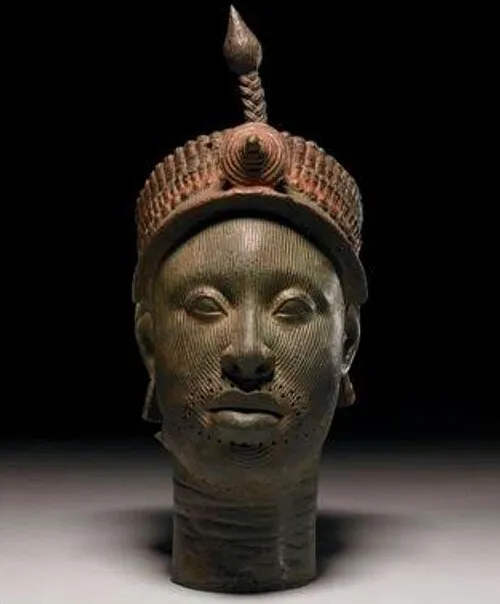
In Yoruba cosmology, truth is rarely spoken plainly. Plain words, the elders say, can be twisted; riddles cannot. Long before the world as we know it existed, there was an Orisa named Esu, a spiritual being both feared and revered. He is remembered as a trickster, though not a malevolent one. His tricks were disruptions intended to expose human pride, to illuminate the blind spots of the self, and to guide devotees toward truths they might never otherwise perceive. Esu’s interventions were carefully calibrated pedagogical acts, designed to provoke reflection and awareness.
Esu is one of the most complex divinities in Yoruba religion. He is so powerful and can be malevolent and benevolent to other divinities, that's why no divinities can operate successfully without first appeasing Esu. Being a senior Orisha, Esu interprets the will of Oludumare to man and carries man’s desires back to Oludumare, the supreme god. He is one of the most complex deities in Yoruba tradition where he is recognised as the keeper of crossroads (ọ̀nà méjì), the meeting point where paths, possibilities, and destinies intersect. The point where life becomes conscious of itself and the paths before it are opened according to the alignment of human actions with truth and integrity.

Among the other Orisas, Esu is so powerful and the most revered that he has every day of the four-day Yoruba week; Ojo Ose, Ojo Aje, Ojo Isegun, Ojo Ojobo, as his days of worship. Being the one who enforces consequence, Ojo Ose became the day he is most revered. Each day carries its own spiritual significance and the Orisa whose energy is strongest that day presides over the affairs of both humans and the spiritual realm. As the opening day, Ojo Ose represents beginnings, decisions, and the unfolding of destiny. On such a day, misalignment reveals itself quickly, because that is the day Esu listens more closely. Essentially Esu is fluid in form and can shapeshift at will, earning the praise name Elagbara, the one with many manifestations, and in philosophical terms is the deity of choice and free will.
In modern thought, shaped by the collision of colonialism and Christianity, Esu is widely misunderstood. Missionaries arriving in Yoruba lands encountered a figure defined by ambiguity, unpredictability, and moral subtlety. Interpreting him through a framework of absolute good versus absolute evil, they identified him as the Devil. This interpretation, though widespread, reflects less about Esu himself than it does about the limits of imposing one cosmology onto another. Over centuries, this misreading has altered the perception of Esu among Yoruba and African audiences alike.
When the missionaries entered Yoruba communities in the 19th century, it wasn't difficult to discover Esu, as unlike other orisas, Esu is highly visible. There were shrines at crossroads and village thresholds, ritual offerings made before journeys, and before opening a market, everyday invocations of Esu in speech and tales. They also relied heavily on myths and local interpreters for translation and interpretations where they learnt most of the things they know about the deity, Esu. Missionaries encountered many oríṣà, but Esu troubled them most, because they did not feel settled with a being that deceives, disrupts, and punishes bad intentions indirectly. Judging by these qualities they saw Esu as a diabolical spirit, translating him through Christian theology, and equating him with the devil that pushes people to do evil. In their thought, they believed that a being that deceives must be evil, and a being that disrupts must oppose God. Although this wasn't quite the case, amongst devotees in the original Yoruba cosmology, the Christian missionaries exerted increasing influence, particularly shaping the perceptions of subsequent generations. To crown it all, while the name Jesus was merely Yorubanized as Jesu Kristi, the figure of the Devil was treated differently. In translating the Yoruba Bible, Samuel Ajayi Crowther went ahead to choose an existing oríṣà within Yoruba belief, Esu, to represent Satan.
What, then, is lost when Esu is reduced to evil? Yoruba elders would say, Èṣù kì í tan ni; ọgbọ́n ẹni ni ń tan án, meaning, Esu will never deceive a person; but their own understanding will. When a person acts wisely, Esu’s influence might lead to a good cause, when a person acts recklessly, the same influence could as well lead to a bad cause. Myths tell of how Ẹ̀ṣù’s riddles function as mirrors, as his effect can save or kill, poison or offer remedy. Same words carry different meanings to different hearers, and each person responds according to their own inner disposition. To reduce Esu to evil is to lose his function as a neutral mediator and moral mirror. In casting him as a diabolical force, the deeper Yoruba insight that morality is not imposed from outside, but revealed from within, is erased.
In the traditional worldview, Esu is not a source of evil but a moral catalyst who creates situations in which choice becomes visible and character is revealed. This is why he is closely associated with consequence rather than causation. By restoring this understanding, Yorùbá moral philosophy re-centers responsibility emphasizing that a person’s actions arise from their own choices rather than from coercion by spirits or unseen forces. It is argued that Oludumare, being a good Being could not have entrusted so much to Esu if he were inherently evil. The fact remains that Oludumare is seen as a perfect Being who cannot create evil. And since He created Esu, this divinity cannot be evil.