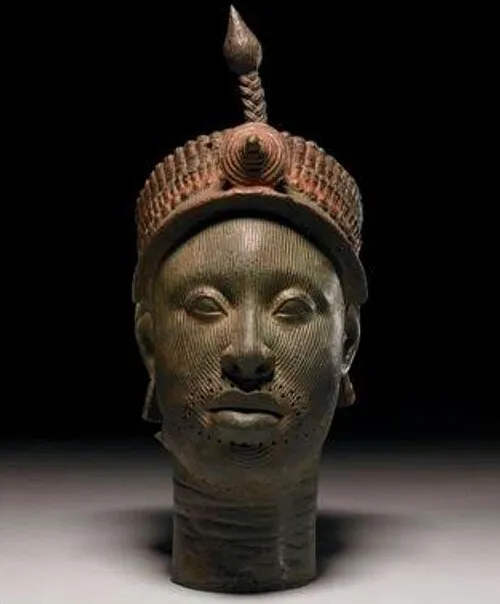
The Bantu peoples of Central Africa hold diverse creation stories. Among the Bushongo (also called Kuba or Bakuba) of the Congo Basin (modern DR Congo), one of the best-known myths centers on Bumba (also called Mbombo or Mbwoom). In Bushongo tradition, Bumba is the supreme creator god (“Chembe”). He begins alone in absolute darkness over primordial waters. As recorded by anthropologist E. Torday (1911):
“In the beginning, the world consisted only of water, and there was absolute darkness. In this chaos, Bumba…reigned alone; he was…of enormous size, and white in colour.”
Suffering intense pain in his stomach, Bumba suddenly vomited forth the first elements of the cosmos. Bumba’s first act of creation was to regurgitate the celestial bodies. He vomited up the sun, moon, and stars. Once the sun appeared, its heat caused the primordial waters to begin to recede and reveal land.
Bumba’s second act was to produce living creatures. He vomited a host of animals, often counted as nine prototypical beings: a leopard (the fierce predator, Koy Bumba), a crested eagle (Pongo Bumba), a crocodile (Ganda Bumba), a small fish (Yo Bumba), a tortoise (Kono Bumba), the lightning (Tsetse Bumba), a scarab beetle, and a goat (Budi). (Some versions also mention a white heron among these first creatures.) Once these first animals were created, each went on to “give birth” to its own kind, thus filling rivers, skies, forests, and fields with life.
Finally, Bumba vomited forth a great number of human beings. Remarkably, only one of these first humans was white like the creator. This man was named Loko Yima, and he became the legendary founder of the Kuba royal line. The myth says that Loko Yima, being as white as Bumba, had special status, and he served as “god upon the earth” once Bumba returned to heaven. All other people descended from him (and from the other vomited men) to populate the world. In this way, the creation story ties Bushongo royal ancestry directly to the divine act of Bumba.
After these main acts, the narrative often adds further details. For example, one tradition speaks of Bumba’s sons completing creation: the first son vomits white ants and dies, and the ants bring up black earth to cover the land; the second son causes the first plants to grow; the third creates the last bird (the kite), the troublesome figure, who withdraws to the heavens. Some versions also describe how the first man, Woot/Woto, stole a sacred basket from Bumba, but eventually humans received its knowledge through a pygmy.
Bumba is the sole creator and first being. Loko Yima (and other sons like Nyonye Ngana, Chonganda, Chedi Bumba) link Bumba’s creation to human history. The animals are often personified (with names containing “-Bumba”) and some act as demiurges for other creatures. An important motif is Tsetse the lightning, who became a troublemaker and is banished into the sky.
This myth is specific to the Kuba (Bushongo) people of the Kasai region in what is now the DR Congo. Different sources may use variant names for the characters: for example, the creator is called Mbombo, Bumba, or Mbwoom (M’Bombo) in different dialects. Some versions list slightly different animals (one mentions a panther instead of a heron, others emphasize the white heron). The number of days and timing of Bumba’s vomiting also varies from telling to telling, but the core elements remain consistent in recorded versions: a solitary giant god in watery chaos who vomits out the sun, moon, stars, animals, and one white man.
Broader Bantu-speaking regions have their own creation tales, but they usually involve different supreme deities (for example, the Kongo people revere Nzambi as creator, the Luba speak of Kabezya-Mpungu) rather than Bumba. The Bumba/Mbombo myth appears to be a distinctive tradition of the Kuba/Bushongo. Outside Africa, oral descendants of the Kuba (such as Maroon communities in the Americas) sometimes preserve traces of the myth, but with local adaptations and new names. In all these variants, however, one finds the same dramatic theme of a supreme being alone in chaos who creates the world by regurgitation or similar bodily means.
Because the Bushongo had a written royal history, some details (like the fate of Bumba’s sons, or the introduction of taboos) reflect historical or social concerns of the Kuba kingdom. In the pre-colonial era, the Kuba were a loose federation of chiefdoms, and myths like this helped legitimise the royal lineage (e.g. by linking kings to Loko Yima) and enforce moral order. Over time, as the story was passed down orally and later recorded by scholars, certain elements were streamlined. Ethnographers such as E. Torday (1911) and folklorists like Jan Knappert (1977) published versions of the Bushongo myth; later retellings (for example, in Barbara Sproul’s compendium) closely follow those earlier accounts.
Anthropologists and mythologists have offered several interpretations of the Bumba narrative. Many scholars note that Bumba’s act of vomiting parallels childbirth. The myth explicitly likens Bumba’s mouth to a womb: as Barbara Sproul observes, the structural similarities “between this and more common birth metaphors (mouth–womb; vomit–baby; pain of delivery)” are clear. In both cases, something sore (like labour pain) culminates in a new creation emerging from within. The vomiting motif thus emphasizes Bumba’s extraordinary fertility: he is so generative that his body literally gives life to the sun, animals, and people.
The myth can be seen as a cosmological drama of divine order emerging from primordial chaos. Initially, the universe is only dark water; Bumba’s acts bring light, land, and living order into the world. Scholars compare this with other myths where a lone supreme being brings life from chaos. Bumba’s creation by bodily expulsion is unusual globally, but it shares the theme of a solitary creator instigating the ordered cosmos. In anthropological terms, the story conveys that the origins of life are not mystical.
The myth also serves to explain and justify the Kuba social structure. The one white man among the first humans (Loko Yima) becomes the ancestor of kings; this symbolizes the divine right of the Bushongo royal line. By descending from Bumba himself, the king is literally a “child of the god,” giving him sacred status. After creating the world, Bumba provides each village with its own set of ancestral taboos and a royal moral code. Scholars interpret this as demonstrating that the source of all social rules comes from the creator. In effect, the myth legitimises political authority and social norms by tying them to a divine origin.
Also, the myth is connected to the Kuba culture and values. For instance, animals have special roles: the heron, crocodile, and others founded by Bumba each go on to create more of their species, linking Kuba respect for animals to this cosmic genealogy. Taboos (muila) and kingship rituals among the Kuba echo the story’s details. In colonial and post-colonial scholarship, Bumba (Mbombo) is often cited as an example of an “ex nihilo” cosmogony, even though Bumba himself is “something” (a god). It stands out for its vivid bodily imagery, and thus has attracted attention in surveys of African mythology.
Notably, modern scholars stress that Bumba’s whiteness is not about race but about purity or power in this context (the Kuba themselves say white symbolises divinity and is unrelated to Europeans). Though unique in its details, the Bumba myth fits into a wider pattern of African origin stories where many African religions feature a single supreme being associated with water or sky.