
The first explosion I heard in Maiduguri arrived as a dull rupture in the night, a low, concussive sound that seemed to pass through walls rather than strike them, followed by a brief, unnatural silence. Only afterward did the city respond: dogs barking, distant shouts, the uneven wail of sirens cutting across the dark. What shattered in that moment was a long-held assumption that education, however difficult, could be pursued as a neutral act, insulated from violence by its moral legitimacy. By 2015, at the height of Boko Haram’s insurgency in northeastern Nigeria, learning itself had become a contested practice, one that unfolded under the constant threat of disruption, injury, or death. This account situates my undergraduate pursuit of education at the University of Maiduguri (UNIMAID) within that historical moment, not as a personal triumph narrative, but as a record of how ordinary educational life persisted, adapted, and fractured under sustained conflict.
Boko Haram, formally known as Jama’at Ahl al-Sunna li al-Da’wa wa al-Jihad, emerged in the early 2000s in Borno State as a Salafi-inspired movement critical of Western education and state corruption, but by 2009 it had transformed into an armed insurgency following a violent confrontation with Nigerian security forces and the extrajudicial killing of its founder, Mohammed Yusuf. From that point onward, the group escalated its campaign against state institutions, religious communities, markets, transport infrastructure, and, crucially, educational establishments. By 2014–2015, Boko Haram controlled significant territory across Borno, Yobe, and Adamawa States, declaring a caliphate and carrying out mass abductions, bombings, and village raids, as documented by Human Rights Watch and Amnesty International. Maiduguri, the Borno State capital, became both a symbolic and strategic target, enduring repeated suicide bombings that killed civilians in markets, mosques, bus stations, and residential areas.
It was into this environment that I chose, at seventeen, to enroll at UNIMAID’s Faculty of Social Sciences, having grown up in Gombe State, a neighbouring region that felt the insurgency’s pressure but not its full intensity. The decision was not taken lightly, nor was it made in ignorance. By 2015, the scale of the conflict was well documented. The Global Terrorism Index ranked Boko Haram among the world’s deadliest militant groups, responsible for thousands of fatalities annually during that period. News reports regularly detailed attacks on schools, including arson, mass killings, and targeted assassinations of teachers, reinforcing the group’s ideological hostility to Western-style education. My family’s resistance to my decision was rooted in this reality. To them, enrolling in a federal university located in the epicentre of the conflict appeared less like ambition and more like recklessness.
My father’s objections were pragmatic, anchored in survival logic that had become widespread among families in the Northeast. Why not attend university in Gombe, or travel south where institutions operated with fewer security constraints? My mother’s opposition was more visceral, shaped by stories circulating through informal networks—of students disappearing on highways, of bombs detonating in lecture theatres, of young people whose academic aspirations ended abruptly in transit. Her fear was not abstract. By 2015, the United Nations Office for the Coordination of Humanitarian Affairs estimated that over two million people had been displaced by the insurgency, many of them women and children, and entire family structures had been fractured by violence. Education, once framed as a pathway to stability, now appeared to invite danger.
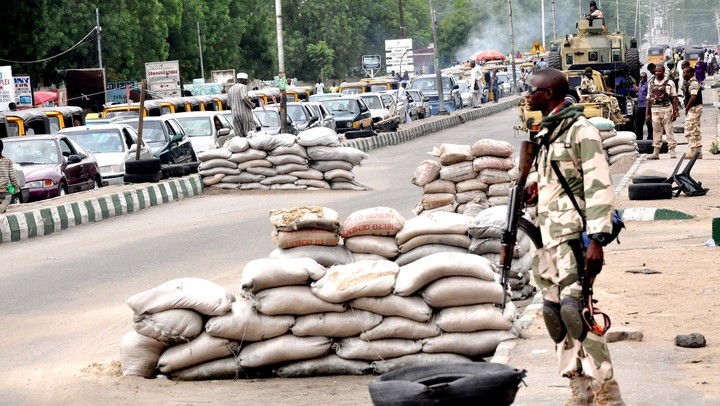
The journey between Gombe and Maiduguri condensed the broader geography of fear into a single experience. The approximately 300-kilometre route along the A3 highway passed through areas subject to military patrols, sporadic ambushes, and intelligence-driven diversions. Commercial buses, often overcrowded with traders, students, and displaced families, became moving capsules of collective anxiety. The physical environment bore the marks of conflict: potholes widened by neglect and explosions, roadside villages thinned by displacement, and makeshift checkpoints constructed from sandbags, scrap metal, and barbed wire. Soldiers manning these barricades scrutinised passengers and luggage with an intensity that reflected the state’s own uncertainty. These delays, sometimes lasting hours, heightened the sense that movement itself had become risky, a vulnerability rather than a right.
Highway attacks were a known tactic of Boko Haram, intended to disrupt state control and spread fear beyond fixed targets. In early 2015, following Boko Haram’s assault on Baga—a town near Lake Chad where satellite imagery later revealed extensive destruction and civilian casualties—the frequency of militant activity along major routes intensified. On one occasion, our bus was diverted without explanation, the driver following whispered instructions relayed at a checkpoint. Inside the vehicle, speculation circulated freely. Some passengers prayed aloud; others sat in silence. The radio crackled intermittently with news updates, often incomplete, sometimes contradictory. This atmosphere of partial information mirrored the broader epistemic uncertainty of the period, where official statements lagged behind lived reality.
Throughout these journeys, my mother’s anxiety found expression in incessant phone calls. She called to ask about my location, the bus’s speed, the presence of soldiers, even the weather ahead, as though information itself could function as protection. These calls, though personally grounding, also revealed the psychosocial toll of the insurgency on families separated by mobility. Scholars studying conflict zones have noted how constant communication becomes a coping mechanism, a way of maintaining relational presence when physical safety cannot be guaranteed. In northeastern Nigeria, this dynamic was intensified by the availability of mobile phones, even as physical infrastructure deteriorated.
Maiduguri itself, upon arrival, presented a city suspended between routine and emergency. Markets operated, children attended school when possible, vendors sold food along dusty roads, yet the presence of armoured vehicles, sandbagged buildings, and armed patrols signalled an abnormal normality. The air often carried a faint smell of smoke, mingling with dust stirred up by military convoys. Sirens punctuated daily life, prompting momentary pauses as residents assessed whether the sound indicated immediate danger or merely another security movement. This sensory environment shaped how residents, including students, navigated space and time.
UNIMAID’s campus offered a paradoxical refuge. Spanning a vast area on the outskirts of the city, it retained many features of conventional university life: lecture halls, libraries, hostels, cafeterias, and academic schedules. Yet these were overlaid with security measures that altered the educational experience fundamentally. Armed guards controlled access points, bag checks became routine, and curfews restricted movement after dusk. In 2014–2015, while UNIMAID had not yet experienced the devastating suicide bombings that would occur in 2017, nearby attacks and intelligence warnings kept the campus in a state of heightened alert. Schools within Maiduguri and surrounding communities were frequently targeted, forcing closures and reinforcing the perception that educational spaces were legitimate sites of violence, as documented by UNICEF’s reporting on attacks on education in Nigeria.
The abduction of 276 schoolgirls from Chibok in April 2014 loomed heavily over student life. Although Chibok lay some distance from Maiduguri, the event became a defining symbol of Boko Haram’s campaign against education, particularly female education. International attention through the #BringBackOurGirls campaign amplified the global significance of the attack, but locally, its impact was deeply personal. Families reassessed the risks of schooling; students altered routines; fear circulated alongside anger and grief. Academic discussions within sociology and political science courses analysed the abductions through lenses of poverty, state failure, and ideological extremism, yet these analytical frameworks coexisted with emotional responses that could not be easily contained by theory.
The presence of internally displaced persons (IDPs) around Maiduguri further complicated the social fabric in which the university operated. By 2015, the city hosted some of the largest IDP camps in Nigeria, including Dalori and Bakassi camps, as documented by the International Organization for Migration. Many students volunteered or conducted informal research in these camps, whether through religious organisations, NGOs, or personal networks. These encounters blurred the line between academic study and lived reality. Concepts discussed in sociology lectures—displacement, social disintegration, resilience, state failure—were no longer abstract. They were embodied in faces encountered outside the classroom. Importantly, the insurgency reshaped peer relationships and solidarities. Students from different ethnic, religious, and regional backgrounds found themselves bound together by shared vulnerability. While Boko Haram’s violence was often framed through religious binaries, daily life at UNIMAID complicated such simplifications. Muslim and Christian students attended the same lectures, shared hostels, and participated in the same study groups, negotiating difference within a context that punished division. This reality contrasted sharply with the insurgents’ ideological narratives and underscores the importance of documenting how pluralism persisted under pressure. Scholars analysing conflict zones caution against narratives that portray affected regions as socially fragmented beyond repair. In Maiduguri’s academic spaces, cooperation remained not only possible but necessary.
As the insurgency gradually weakened after 2015 due to intensified military operations and regional cooperation through the Multinational Joint Task Force, the immediate frequency of attacks in Maiduguri declined, though insecurity did not disappear. This shift altered, but did not erase, the psychological imprint left on students who lived through the peak years. Fear became less acute but more ingrained, transforming into caution and habitual preparedness. Even as lectures resumed with greater regularity, the memory of disruption lingered. For many students, academic progress was uneven, marked by interruptions that extended graduation timelines and reshaped career trajectories. These outcomes reflect broader findings by the World Bank, which has documented how conflict-induced educational disruption produces long-term economic and social consequences for affected populations.
From a historical standpoint, it is crucial to resist narratives that treat education during the Boko Haram insurgency as either heroic exceptionalism or total collapse. The reality was more ambiguous. Education persisted, but unevenly. It was sustained not by institutional resilience alone, but by individual and collective improvisation. Students attended lectures while monitoring security updates, studied amid sirens, and planned futures in short horizons. This form of endurance does not fit neatly into celebratory frameworks, yet it constitutes a significant chapter in Nigeria’s educational history.
By 2025, as national discourse shifted toward new challenges—economic restructuring, technological change, debates over artificial intelligence—the memory of education under insurgency risked fading into abstraction. Yet for those who lived it, the experience remained formative. It shaped how authority was perceived, how knowledge was valued, and how institutions were trusted. Documenting these experiences is not an exercise in nostalgia, but an act of historical preservation. Without such records, the everyday realities of learning under siege risk being compressed into statistics or mythologised accounts divorced from material conditions.
In preserving this history, the aim is not to romanticise suffering, but to clarify how education functioned as a contested social practice during one of the most violent periods in Nigeria’s recent past. The University of Maiduguri did not stand apart from the insurgency; it existed within it, shaped by it, and, in quiet ways, resisted it. Understanding this dynamic contributes to broader conversations about education in conflict zones, the limits of institutional protection, and the capacities of students to navigate uncertainty. These lessons remain relevant, not only for Nigeria, but for regions globally where learning continues under the shadow of violence.


