Childhood Reflection on a Local Folklore: Re-encountering Ijapa the Tortoise
By Nneoma Sally

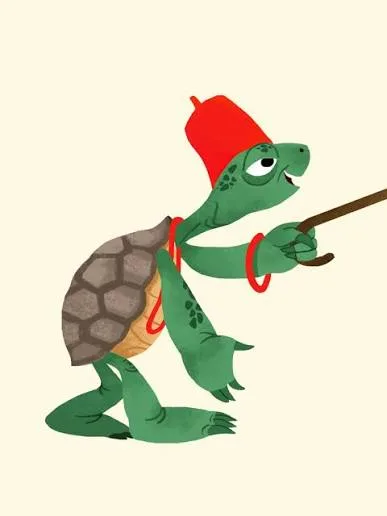
Fig. 1. The Tortoise
When I was a child, my mother gave me a book of folklores that I read constantly, drawn to them because the stories were intriguing, predictable, and laced with comedy. At that age, I never thought they were written vessels that carried a deep moral lesson, nor did I try to decipher why the Tortoise monopolised so much of our local folklore. My childhood goal was simply to connect the Tortoise of one story to his brothers in the next, tracking which ones were yet to experience any misfortunes and which ones were on the verge of it, even though they all shared the singular name of "Tortoise". As I grew older, however, the deep lore surrounding the tortoises – also known as "Mbe" in the Igbo language and "Ijapa" in Yoruba – intrigued me. It prompted me to recall one peculiar story I once dismissed as ridiculous because the Tortoise seemed especially foolish. But I now recognise it as a psychological case study of individual greed versus communal survival.
In this specific story, greed operates as the primary antagonist, while self-restrain functions as its elusively ethical rival. However, modern society rarely capitalises on these primary morals, seeing them merely as passive traits of human behaviour. So, instead, we get warnings against greed through subtle encoding and self-restraints through displays of public observations. This narrative, however, lays its foundation quite differently from modern society, laying it thick on greed while barely shining a spotlight on self-restraint.
The story began with Tortoise’s growling stomach. The oral narration does not specify where he was staying or whether he was indoors or out, but such ambiguity is the standard in many local folklores. However, we are quite aware that every Tortoise story requires a precise catalyst to ignite his curiosity. In this story, the catalyst arrived as a rich aroma drifting directly into his nostrils. He reacts to this instigator by straightening his back and sniffing the air. The action caused his stomach to grumble fiercely, and he scrambled to track the scent.
He followed its trail until he reached the threshold bordering his neighbour’s compound – the family of dogs (Nkita in the Igbo language and Aja in Yoruba). Now in the broader ecosystem of Yoruba folklore, dogs are usually depicted as hard-working fellows, quietly working behind the scenes to keep hardship from affecting their households. Yet, they are also cast as innocent, rule-abiding citizens who behave with upfront honesty that often subjects them to Tortoise tricks.
However, in this particular story, there’s no preface that dictates the dogs’ behaviour. The narrative only introduces them as Tortoise’s neighbours and unwilling participants in instigating his ire. Here, we find them running helter-skelter, preparing a massive pot of yam porridge as if they were expecting an esteemed visitor. The Tortoise, being the sneaky animal that he is, concealed himself from the dogs. He watched them preparing the delicious meal, wondering just how he might secure the entire meal for himself without handing a single morsel to the dogs – the rightful owners.
Such were his thoughts on the matter, entirely bypassing the deeply ingrained culture of communal feeding within the Yoruba culture. This tradition of hospitality does not operate on the system of mutual exchange; rather, it fosters communal love among neighbours and absolute strangers. So, it isn’t entirely strange to invite a passerby to eat, especially if they show visible signs of hunger. However, Tortoise refused to leverage this particular custom, choosing instead to spend his energy hatching a hostile plan against the dog family. The scent of the cooking yam porridge is probably already clouding his thoughts, swirling on his tongue like he could taste the plump, soft, fresh yam garnished with pepper and vegetables. So much so that the mere thought of asking politely vanishes from his mind.
After hatching his master plan, he stepped into the compound and falsely announced that the king had summoned the canines. Mirroring every classic local folklore where innocent characters fall for the first trick, the dogs leave Tortoise in charge of their home and run to answer the king. Tortoise watched them go before rushing directly to the source of his treachery. He scooped and ate and scooped and ate until he heard the echo of paws signalling that the dogs were rushing back home. A modern observer might wonder why Tortoise couldn’t have accepted defeat or, better still, ask the dogs for a bowl now that he had taken a bite.
But that observer would also agree that greed, when mixed with a high dosage of pride, forces the intellect to make irrational choices or calculations. In this scenario, Tortoise genuinely believed he could defy the laws of satiety by finishing the entire pot in one sitting – and within a few minutes, mind you. He probably hadn’t calculated the logistics of consumption, nor did he consider the scalding hotness of the food. And so we watch as panic sets in, wondering what he would do next. Then, an absurd but desperate plan strikes him: he should stuff the remaining yam porridge into his hat!
The story notes that his hat is old and worn out from constant use. But I’m assuming Tortoise ignores how dirty or smelly the sweat-stained fabric might be from years of constantly protecting his head. Nevertheless, he puts his plan into motion, packing the scalding yam porridge into his hat and forcing the bulging object back onto his head. However, he wasn’t fast enough to get away, and the dogs caught up to him, deeply infuriated that he made them run all the way to see a king that never summoned them.
So, they stall Tortoise, demanding an explanation for what he did. Tortoise stood on his toes, straining to bypass them, but he couldn’t break through. The scalding yam porridge was gradually becoming unbearable until finally, in agony, Tortoise rips the hat off and hurls it away, relieving himself of the pain in his head but completely exposing his shame. The dogs do not need to put two and two together to understand why their neighbour, the Tortoise had sent them away. Tortoise stood there, his head entirely devoid of any hairs, soaking in absolute public shame.
Reading this folklore as a child was genuinely terrifying. The Tortoise’s shame was especially contagious because somehow, it redirected onto me so vividly that I feared if I ever lost all my hair, the entire world would assume I stuffed scalding porridge up my hat. However, looking back as an adult, I see the true value of this story. It doesn’t centre on the public shame that’s a result of Tortoise greed. Instead, it serves as a reminder of unchecked greed when it’s allowed to run rampant in the real world, illustrating why it could be a source of our social isolation. Whilst self-restraint, its resulting virtue, secures structural respect, shielding us from self-inflicted ridicule and preventing the needless enmity that fractures our shared human connections.
References
Elizabeth Yakubu, “And the Tortoise Burnt His Head!,” My Sasun African Market (blog), March 8, 2024, https://mysasun.com/blogs/bloglearning-bytes/and-the-tortoise-burnt-his-head. Malakai Bassey, “10 Funny Tortoise Stories Nigerian Kids Can Never Forget,” Zịkoko (blog), November 3, 2021, https://www.zikoko.com/life/oldies/funny-tortoise-stories/. Ezeokeke Henry, "Mbe The Tortoise," Instagram, https://www.instagram.com/p/DXJjW-VDMKN/
Reader's Choice is decided by readers and is separate from the judged places. See the whole shortlist